

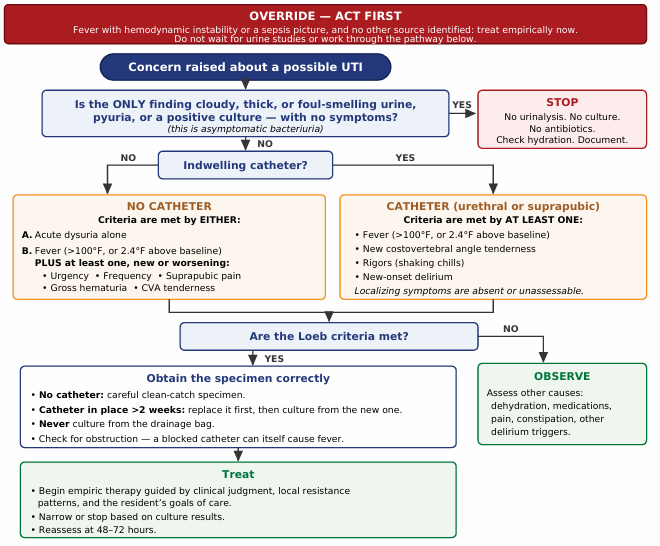
Suspected urinary tract infection is the most common trigger for antibiotic use in long-term care, yet the majority of these episodes do not represent a true, treatable infection. This report consolidates the IDSA asymptomatic bacteriuria guideline, the Loeb minimum criteria, and the supporting outcome literature into a single reference for physicians, nurse practitioners, physician assistants, nursing staff, and hospice staff. The goal is to align all provider practices with the facility’s antibiotic stewardship program.
Cloudy, thick, or foul-smelling urine is not a reason to test or treat. Urine appearance and odor reflect hydration and are excluded as criteria by both IDSA and Loeb.
Pyuria does not indicate infection in this population. Roughly 90% of long-term care residents with asymptomatic bacteriuria also have pyuria, so a “positive” urinalysis rarely changes the diagnosis.
New confusion or a fall, without fever or hemodynamic instability, should prompt a broad evaluation — not a urine culture. Delirium in these residents is far more often caused by medications, retention, dehydration, or pain than by a UTI.
Catheterized residents follow a distinct pathway: a higher bar to begin looking (systemic signs only), but a lower bar to treat once those signs appear, given the catheter’s direct route to the bloodstream.
Reducing antibiotic use through these criteria is supported by evidence. Four randomized trials found no increase in hospitalization, sepsis, or death, while the harms of overtreatment — Clostridioides difficile, resistance, and adverse drug events are well documented.
Antibiotic decisions by hospice and other consulting services fall within our stewardship program’s scope and are surveyable under F881, making shared criteria a compliance issue as well as a clinical one.
Download PDF: Cloudy Urine, Pyuria, and UTI: A LTC Reference
Cloudy Urine, Pyuria, and UTI: A Long-Term Care Reference
Audience: Physicians, nurse practitioners, physician assistants, nursing staff, and hospice staff working in post-acute and long-term care (PALTC) settings.
1. Decision flowchart
Figure 1. Decision pathway for suspected urinary tract infection in long-term care, based on the Loeb minimum criteria and the IDSA asymptomatic bacteriuria guideline. On narrow screens the chart scrolls horizontally.
- Cloudy, thick, dark, or foul-smelling urine
- Pyuria on urinalysis — present in about 90% of long-term care residents who have asymptomatic bacteriuria
- A positive urine culture in a resident without symptoms
- A fall, without fever or hemodynamic instability
- New confusion or delirium, without fever or hemodynamic instability
2. What actually counts as a diagnostic sign (IDSA Recommendation V)
The IDSA guideline defines the classic symptoms of UTI as focal genitourinary findings: urinary frequency, urgency, dysuria, and costovertebral angle tenderness. Residents without focal genitourinary symptoms are, by the guideline’s definition, considered asymptomatic.
Urine color, clarity, and odor appear nowhere in either recommendation. The guideline panel specifically searched for a more reliable marker than nonspecific symptoms and concluded that neither pyuria nor inflammatory markers such as interleukin-6 can separate asymptomatic bacteriuria from true UTI in this population — much less something as nonspecific as turbid urine.
3. The Loeb minimum criteria — the bedside tool
IDSA sets the evidence-based policy: do not screen for or treat asymptomatic bacteriuria. The Loeb minimum criteria (2001 consensus conference) translate that policy into a bedside decision rule. They were built for real-time use in long-term care, often before any lab results are available, which makes them the right tool for nursing and hospice staff performing the first-line assessment on evenings, nights, and weekends.
Resident WITHOUT an indwelling catheter
- Acute dysuria alone, or
- Fever (above 100°F, or a 2.4°F rise above the resident’s own baseline) plus at least one of these, new or worsening: urgency, frequency, suprapubic pain, gross hematuria, costovertebral angle tenderness, or urinary incontinence.
Resident WITH an indwelling catheter (urethral or suprapubic)
- Fever (above 100°F, or a 2.4°F rise above baseline)
- New costovertebral angle tenderness
- Rigors (shaking chills)
- New-onset delirium
3a. What this means for each role
| Role | Practical application |
|---|---|
| Nursing staff | Cloudy or dark urine noticed during rounds or personal care is a cue to check hydration, offer fluids, and assess the resident overall — not, by itself, a reason to request a urinalysis with culture. Report the observation along with vital signs and any Loeb criteria symptoms so the provider gets the full picture. |
| Physicians, NPs, and PAs | When staff report cloudy urine, ask specifically about Loeb criteria findings before ordering a urinalysis or culture. If none are present, document the reasoning for holding off. This is both good stewardship and defensible documentation. |
| Hospice staff | In comfort-focused care, unnecessary cultures and antibiotics add burden — catheterization to obtain a specimen, blood draws, gastrointestinal side effects, and Clostridioides difficile risk — with no offsetting benefit. Cloudy urine alone is not a reason to escalate. Focus the assessment on comfort: pain, restlessness, or genuine localizing signs, consistent with the resident’s goals of care. |
4. Indwelling catheters follow a different pathway
Residents with an indwelling urethral or suprapubic catheter are evaluated differently from other residents. Two things change at once, and they pull in opposite directions.
4a. Why the diagnostic bar is different
- Bacteriuria is universal, so it is not diagnostic. After a catheter has been in place more than a few days, essentially every resident will have bacteriuria and pyuria from biofilm on the catheter, whether or not an infection exists. A positive culture or dipstick tells you almost nothing on its own.
- Localizing symptoms largely disappear. Dysuria, urgency, and frequency are usually absent or unassessable because the catheter bypasses normal bladder sensation. This is why the Loeb criteria for catheterized residents drop the localizing symptom list entirely and rely only on systemic signs.
- Cloudy or foul-smelling catheter urine remains non-diagnostic — arguably more so than in other residents, because biofilm, sediment, and urinary stasis in the drainage bag make turbid urine both more common and less meaningful.
4b. Why the treatment threshold is lower once a real signal appears
When a catheterized resident does develop a genuine systemic sign — fever, rigors, new hemodynamic instability, or unexplained delirium — with no other apparent source, the threshold to treat empirically is lower and more urgent than for a resident without a catheter presenting the same way. The catheter provides a direct route for bacteria to ascend from a colonized biofilm into the bloodstream, and urosepsis can develop quickly once true infection takes hold.
4c. Practical steps specific to catheters
| Step | Detail |
|---|---|
| Never culture from the drainage bag | Bag urine reflects biofilm and stagnant contents, not bladder flora. |
| Replace a long-standing catheter before culturing | If the catheter has been in place more than two weeks and is still indicated, replace it and obtain the culture from the new catheter. Old catheter urine over-represents biofilm organisms. |
| Consider removal instead | If catheterization can be discontinued, a voided midstream specimen is preferable, and removal alone sometimes clears bacteriuria without antibiotics. |
| Do not screen catheters for bacteriuria | IDSA recommends against screening or treating catheter-associated asymptomatic bacteriuria for both short-term (under 30 days) and long-term catheters. Only symptomatic infection meeting criteria warrants treatment. |
| Rule out obstruction | A blocked, kinked, or non-draining catheter can itself produce fever and rigors. Check for mechanical obstruction before or alongside starting antibiotics. |
4d. What this means for each role
| Role | Application to catheterized residents |
|---|---|
| Nursing staff | Report cloudy or sediment-laden catheter urine as a routine observation. Escalate promptly for fever, rigors, new confusion, or a catheter that is not draining — these are the findings that actually warrant a same-day call. |
| Physicians, NPs, and PAs | Avoid culturing standing catheter urine for nonspecific complaints. If systemic signs are present, treat empirically while awaiting a culture drawn from a freshly placed catheter, rather than waiting for results. |
| Hospice staff | The same principle applies: do not pursue cultures for cloudy urine alone. If genuine systemic signs of infection are causing distress, weigh treatment against the resident’s goals of care — untreated symptomatic urosepsis can itself be a significant source of discomfort. |
5. Pyuria does not reliably indicate UTI
5a. What the guidelines state
The 2005 IDSA guideline concluded that pyuria alone is not sufficient to diagnose bacteriuria, and that its presence or absence does not distinguish symptomatic from asymptomatic urinary infection. Pyuria also arises from noninfectious causes such as interstitial nephritis, further limiting its specificity.
The 2019 update carries this forward in the definition of asymptomatic bacteriuria itself, which is written to apply “irrespective of the presence of pyuria.” Pyuria is therefore not part of what separates asymptomatic bacteriuria from UTI at all. The 2019 panel also reviewed whether pyuria, interleukin-6, or heparin-binding protein could distinguish the two in nursing home residents, and found that none of them reliably can.
5b. How common pyuria is, even without infection
| Population | Prevalence of asymptomatic bacteriuria | Pyuria among those with asymptomatic bacteriuria |
|---|---|---|
| Healthy premenopausal women | 1–5% | ~32% |
| Female long-term care residents | 25–50% | ~90% |
| Male long-term care residents | 15–50% | ~90% |
| Patients receiving hemodialysis | ~25% | ~90% |
| Residents with an indwelling catheter | >90% | 50–100% |
Adapted from published asymptomatic bacteriuria stewardship education materials citing IDSA 2019 and Midthun & Lindseth (2004).
The practical implication: roughly nine out of ten long-term care residents with asymptomatic bacteriuria will also have pyuria. A urinalysis showing white cells therefore says almost nothing about whether a given resident has a true UTI. It mostly confirms what is already known — that bacteriuria is common in this population.
6. New delirium is usually not caused by a UTI
6a. The most direct test of the hypothesis
If urinary infection commonly caused delirium, acutely confused residents should have more bacteriuria than residents who are not confused. They do not. In a cohort across 22 Swedish nursing homes, bacteriuria prevalence was essentially identical between residents with nonspecific symptoms including confusion (31% of 85) and those without (32% of 336; p = 0.74). Interleukin-6 concentrations likewise did not differ between bacteriuric residents with and without nonspecific symptoms.
6b. What the IDSA panel concluded about causation
Observational studies do report that delirious patients are more often bacteriuric. The 2019 IDSA panel examined these studies and found that confounders such as age, comorbidity, and reduced mobility were not fully adjusted for, that residual confounding is likely, and that a causal relationship between bacteriuria and delirium has not been established. Their interpretation was that the association reflects shared underlying host factors and the high background frequency of both events in this population, rather than infection driving the confusion.
Consistent with this, in the one larger nursing home cohort where an association initially appeared, a follow-up analysis of the same residents found that change in mental status was no longer significantly associated with the number of bacteriuria episodes once resident-level factors were taken into account.
6c. Treatment does not resolve the delirium
This is the most practical line of evidence. If bacteriuria were driving the confusion, treating it should improve it.
| Study | Finding |
|---|---|
| Randomized trial of norfloxacin vs placebo in long-term care residents with asymptomatic bacteriuria, no fever and no urinary symptoms (29 per arm) | Behavioral rating scores worsened in both arms. Antibiotic treatment did not improve mean behavioral scores at end of treatment or at 1 and 3 months. |
| Prospective study of hospitalized patients aged 70 and older, screened for delirium every 2 days | Among 68 delirious patients whose asymptomatic bacteriuria was treated versus 22 untreated, there was no significant difference in functional recovery (RR 1.10; 95% CI 0.86–1.41). Delirious patients treated for bacteriuria had poorer functional outcomes than untreated bacteriuric patients without delirium (adjusted OR 3.45; 95% CI 1.27–9.38) and were more likely to develop Clostridioides difficile infection (OR 2.45). |
| Observational cohort of 320 hospitalized patients with urine cultures sent | Confusion or mental status change was the indication for culture in 57%. Patients with confusion were treated far more often than those without (75% vs 43%; OR 1.81; 95% CI 1.19–4.12), without a corresponding difference in mortality. |
6d. The differential diagnosis is large, and much of it is treatable
A systematic review of 315 studies covering 101,144 patients identified 33 predisposing and 112 precipitating factors associated with delirium, with heterogeneous underlying mechanisms. Urinary infection is one entry on a long list. Consider these before attributing new confusion to the urine:
| Category | Examples to assess at the bedside |
|---|---|
| Medications | New or recently changed drugs, anticholinergic burden, opioids, benzodiazepines, sedative-hypnotics, steroids, withdrawal from alcohol or benzodiazepines |
| Urinary and bowel | Urinary retention (a delirium precipitant independent of infection), constipation, fecal impaction |
| Fluid and metabolic | Dehydration, hyponatremia, hypercalcemia, hypoglycemia and hyperglycemia, uremia, thyroid dysfunction |
| Other infection | Pneumonia, cellulitis or wound infection, influenza or COVID-19, intra-abdominal source |
| Cardiopulmonary | Hypoxia, heart failure exacerbation, myocardial infarction (often silent), arrhythmia |
| Neurologic and trauma | Unwitnessed fall with head injury or subdural hematoma, stroke, seizure or postictal state |
| Pain and sensory | Untreated pain, occult fracture, missing hearing aids or glasses |
| Environmental | Sleep disruption, room or roommate change, recent hospitalization or transfer |
6e. Why the misattribution is so persistent
The base rates explain it. Asymptomatic bacteriuria is present in roughly 25–50% of female and 15–50% of male long-term care residents (Section 5). Culture the urine of a delirious resident and a positive result will come back a large share of the time by chance alone, entirely independent of what caused the confusion. The clinician feels confirmed, antibiotics are started, the delirium eventually fluctuates or resolves on its own — and the association is reinforced for the next resident. Sending the culture in the first place is what manufactures the false confirmation.
7. Is it safe? Outcome data on applying these criteria
The most common objection to withholding antibiotics is the fear of missing a serious infection. Four cluster randomized controlled trials have measured hospitalization and mortality when nursing homes adopt Loeb-style criteria. None found evidence of harm.
| Trial | Design | Safety outcome |
|---|---|---|
| Loeb et al., BMJ 2005 — the criteria tested by their own author | 24 nursing homes in Ontario and Idaho; 12 randomized to a diagnostic and treatment algorithm, 12 to usual care; outcomes measured in 4,217 residents | Antibiotic prescriptions for suspected UTI fell, with no significant difference in hospital admissions or mortality. All-cause admission 0.98 vs 0.81 per 1,000 resident-days (weighted mean difference 0.17; 95% CI −0.14 to 0.48). Admission for sepsis of suspected urinary or unknown origin 0.026 vs 0.018 per 1,000 resident-days (weighted mean difference 0.008; 95% CI −0.025 to 0.039). |
| Arnold et al., Lancet Infect Dis 2021 (Denmark) | Cluster randomized trial of a tailored staff intervention | Reduced antibiotic prescriptions and inappropriate UTI treatment without substantially influencing all-cause hospitalizations or mortality. |
| Netherlands EHR trial, JAMDA 2021 | 16 nursing homes, 295 suspected UTIs; EHR-integrated decision tool vs usual care, 21-day follow-up | Complications (2% vs 3%), UTI-related hospitalization (2% vs 1%), and possible UTI-related mortality (2% vs 2%) were rare and comparable between arms. |
| Pasay et al., Infect Control Hosp Epidemiol 2019 (rural Alberta) | 42 nursing homes; staff education, physician academic detailing, and clinical decision tools | No difference in hospital admissions (0.00 per 1,000 resident-days; 95% CI −0.4 to 0.3; p = 0.76). Mortality rate slightly lower in the intervention arm. |
7a. Reading these results honestly
- In the 2005 Loeb trial, both hospitalization point estimates numerically favored usual care, but the confidence intervals were wide and crossed zero. This is a null result, not a demonstrated safety benefit.
- These trials were powered to detect changes in prescribing, not rare events like urosepsis or death. Absence of a detected signal is not proof of equivalence for uncommon catastrophic outcomes.
- What was actually tested was a multifaceted intervention built around the criteria — education, algorithms, academic detailing — not rigid protocolized enforcement. The realistic claim is that nudging practice toward Loeb criteria is safe, not that mechanical rule-following is.
- None of these trials isolate the highest-risk subgroups, such as catheterized residents or men over 85. This is precisely why the catheter pathway in Section 4 preserves a lower threshold to treat once systemic signs appear.
7b. The study that gets cited against stewardship
Gharbi et al. (BMJ 2019) is frequently raised as a counterargument and is worth understanding. In 312,896 UTI episodes among UK primary care patients over 65, hospital admission rates were roughly double with no antibiotics (27.0%) or deferred antibiotics (26.8%) compared with immediate antibiotics (14.8%). All-cause 60-day mortality was higher with deferred antibiotics (adjusted HR 1.16; 95% CI 1.06–1.27) and with no antibiotics (adjusted HR 2.18; 95% CI 2.04–2.33). Men over 85 were at particular risk.
- Different population. These were community-dwelling patients who had already received a clinical diagnosis of UTI — meaning they had symptoms. The Loeb criteria never direct anyone to withhold antibiotics from a resident with dysuria and fever. They direct against testing and treating residents who have no symptoms at all.
- Confounding by indication. Patients not prescribed antibiotics at an index visit are often frailer, sicker, at end of life, or presenting atypically. The accompanying editorial cautioned that the association may not be causal.
- Study design. This is a retrospective cohort study. The evidence supporting Loeb-based practice consists of randomized trials.
8. Supporting evidence from long-term care
| Finding | Detail |
|---|---|
| Only 16% of bacteriuric residents with advanced dementia met minimum criteria for symptomatic UTI, yet 75% of them were treated with antibiotics. | IDSA 2019, Section IV evidence summary |
| Antibiotic treatment in that group conferred no survival benefit, even after adjusting for functional status, temperature, and mental status change. | Adjusted hazard ratio for death 1.09 (95% CI 0.43–2.75) |
| Nonspecific symptoms (fatigue, anorexia, confusion, falls, aggression, restlessness) did not correlate reliably with pyuria, interleukin-6, or heparin-binding protein in bacteriuric residents. | IDSA 2019, Section IV evidence summary |
| In a cohort across 22 Swedish nursing homes, bacteriuria prevalence was no different between residents with nonspecific symptoms including confusion (31%) and those without (32%). | p = 0.74; IDSA 2019, Section V evidence summary |
| Only 20% of nursing home fall episodes occurred in residents who actually had both bacteriuria and pyuria. The other 80% had neither. | IDSA 2019, Section V, falls subsection |
| Cloudy urine appears in the IDSA guideline only for spinal cord injury patients, whose absent bladder sensation makes standard symptoms unusable. That list was never extended to general geriatric or long-term care use, and even within it, residents predicted the absence of UTI better than its presence. | IDSA 2019, Section X |
9. Quick decision framework
| Finding | Does it justify testing or treatment? |
|---|---|
| Cloudy, thick, or malodorous urine alone | No — not an indication for urinalysis, culture, or antibiotics |
| Pyuria on urinalysis alone | No — expected background finding in this population |
| Positive urine culture in an asymptomatic resident | No — this is asymptomatic bacteriuria; do not treat |
| New dysuria, urgency, frequency, suprapubic or flank pain, CVA tenderness | Yes — classic localizing symptoms |
| New delirium or mental status change without fever or hemodynamic instability | No — assess other causes first (Rec V.1) |
| Fall without fever or hemodynamic instability | No — assess other causes first (Rec V.2) |
| Fever, hemodynamic instability, or sepsis picture with no other source | Yes — empiric therapy appropriate pending cultures |
| Catheterized resident with fever, rigors, or new delirium | Yes — lower threshold; treat empirically and check for obstruction |
10. Suggested documentation language
“Resident noted to have cloudy/concentrated urine. No dysuria, urgency, frequency, suprapubic or flank pain, fever, or hemodynamic instability. Per IDSA 2019 asymptomatic bacteriuria guideline (Recommendation V) and Loeb minimum criteria, cloudy urine alone, in the absence of localizing genitourinary symptoms or systemic signs of infection, does not meet criteria for UTI evaluation or treatment. Hydration status assessed; [intervention/plan]. Will continue clinical observation and reassess if localizing or systemic signs develop.”