Skip to content
  • Fri. Apr 24th, 2026
docShepherd

docShepherd

  • Med Director Report
  • Education
  • Internal Med

PALTmed-Colorado

  • Antimicrobial stewardship
  • Antiplatelet and Anticoagulant use in CVA CAD: the transition to monotherapy
  • Learning points from PALTC26 Conference - Colorado speakers
  • Secondary Prevention After Ischemic Stroke / Peripheral Artery Disease in the Lower Extremities
  • HEART FAILURE: The Guidelines, The Latest, Considerations with Older Adults

Resources

  • CMS QAPI Guide
  • Elements of Plan of Correction
  • Facility Reported Incidents
  • CO Regs
    • / LTC Regulations
    • / Standards for Licensure
    • / Occurrence Reporting Manual
  • Pharmacy
    • Drug Shortage Information ASHP
  • CDPHE
    • / Reportable Infectious Diseases | CDPHE
    • / CDPHE RPP webpage
    • / Mitigation guidance
    • / State Op Manual - Appendix PP (cms.gov)
  • COVID-19 /Influenza / RSV
    • /COVID-19, influenza, and RSV resources for residential and long-term care facilities | Colorado Department of Public Health and Environment
    • / Managing HCP with covid infxn or exposure
    • / Liverpool COVID-19 Interactions
  • Antibiotic Stewardship and Infection Control
    • / Antimicrobial Stewardship in LTC -CDPHE
    • / Nursing Home Antibiotics Guidelines Summary Resource CDPHE
    • / Graphics and Videos | Be Antibiotics Aware Partner Toolkit | Antibiotic Use | CDC
    • / Viral respiratory diseases report CDPHE
    • / RESP-NET Interactive Dashboard | CDC
    • / COVID-19, influenza, and RSV resources for LTC | CDPHE

  • F-Tag Help -- Search

MedPageToday

  • AOC vs RFK Jr. Memes; Are Doctors OK? Communicating With Gen Z Patients
  • 'Ozempic Personality': Is Emotional Flattening Another Side Effect of GLP-1s?
  • First Gene Therapy Approved for Hearing Loss
  • Think Heart Attacks Cause Most Sudden Cardiac Deaths? Think Again, Study Says
  • FDA, CMS to Launch Speedy Coverage Pathway for Breakthrough Medical Devices

JAMDA

  • Long-Term Residential Care and Racism: A Scoping Review
  • Medicaid Home- and Community-Based Services Rebalancing Is Concentrated in Large Urban Areas
  • Leveraging Pharmacists Using RE-AIM Framework to Implement Age-Friendly Nursing Home Care
  • Ensemble Machine Learning Models for Predicting Death in Post-Acute Skilled Nursing Facilities
  • Implementation of a Systematic Patient Mobility Program Across 5 Hospitals

ACP AD advanced care planning advanced directive alz alzheimers antipsychotics anxiety bells bowel CDPHE CME COVID covid vaccine covid vax CVA dementia depression docusate education Falls infection infection control iron mcgeer measles MedicalDirectorReport Mg milk of magnesia MOM MOST myocarditis Pain/opioid psych RespProtectProg RLS RPP rsv ssi stroke TB UTI vaccine Vision   HEALTH ADVISORY 

Uncategorized

Fwd: The Cardiopulmonary Effects of the N95 Mask

Bydashephe

Jun 13, 2023
Print PDF
The Methods Man

The Cardiopulmonary Effects of the N95 Mask

F. Perry Wilson — June 12, 2023

You folks know I wrote a book, right?

A carefully-controlled study finds – not very much.

There was a time when I would have had to explain to you what an N95 mask is. How it is designed to filter out 95% of fine particles, defined as stuff in the air less than 2.5 microns in size.

But of course, you know that now. The N95 had its moment –  a moment that seemed to be passing as the concentration of airborne coronavirus particles decreased.

But, as the poet said, all that is less than 2.5 microns in size is not coronavirus. Wildfire smoke. That is also chock full of fine particulate matter. And so, N95s are having something of a comeback.

That’s why an article that took a deep look at what happens to our cardiovascular system when we wear N95 masks caught my eye. In a carefully controlled experiment, you can prove that, from the perspective of your heart, wearing these masks is different than not wearing these masks – but just barely.

Mask wearing has been the subject of intense debate around the country. While the vast majority of evidence, as well as the personal experience of thousands of doctors suggest that wearing a mask has no significant physiologic effects, it’s not hard to find those who suggest that mask wearing depletes oxygen levels, or leads to infection, or has other bizarre effects.

In a world of conflicting opinions, a controlled study is a wonderful thing, and that’s what appeared in JAMA Network Open this week.

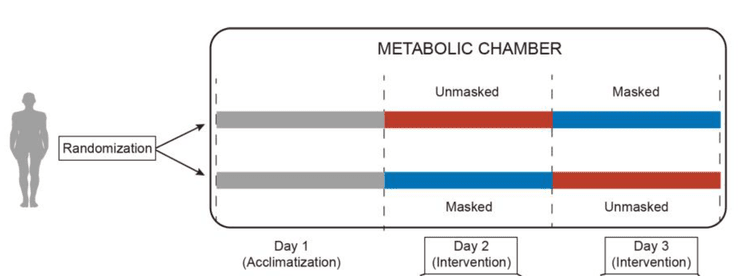
This isn’t a huge study, but it’s big enough to make some important conclusions.  30 individuals, all young and healthy, half female, were enrolled. Each participant spent three days in a metabolic chamber – this is essentially a giant airtight room where all the inputs (oxygen levels and so on) and outputs (carbon dioxide levels and so on) can be precisely measured.

Source: JAMA Network Open

After a day of getting used to the environment, the participants spent a day either wearing an N95 mask, or not for 16 waking hours. On the next day, they switched. Every other variable was controlled, from the calories in their diet to the temperature of the room itself.

They engaged in light exercise twice during the day – riding a stationary bike – and a host of physiologic parameters were measured. The question of course being – would the wearing of the mask – for 16 hours straight – change anything.

And the answer is yes – some things changed – but not by much.

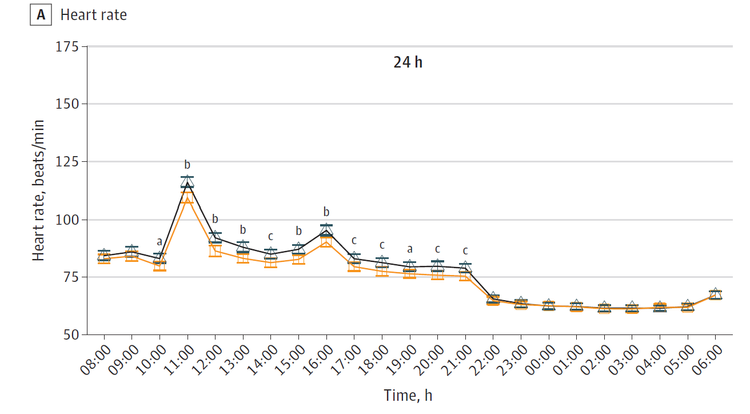
Here’s a graph of the heart rate over time.  You can see some separation, with higher heart rates during the mask wearing day, particularly around 11am – when light exercise was scheduled. 

Source: JAMA Network Open

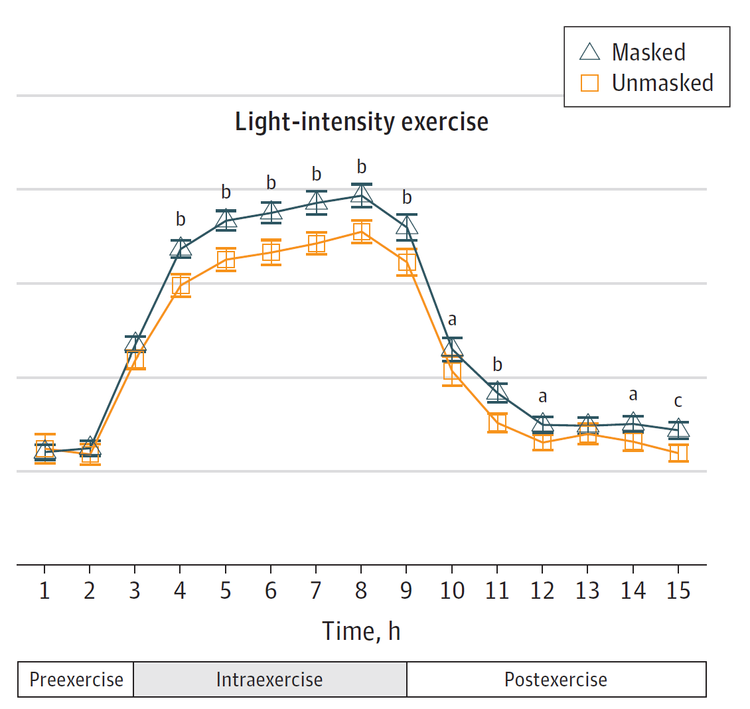
Zooming in on the exercise period makes the difference more clear. The heart rate was about 8 beats per minute higher while masked and engaging in exercise.  Systolic blood pressure was about 6mmHg higher. Oxygen saturation was lower by 0.7%.

SOURCE: JAMA Network Open

So yes, wearing an N95 mask while you’re exercising might be different than exercising without an N95 mask. But nothing here looks dangerous to me. The 0.7% decrease in oxygen saturation is smaller than the typical measurement error of a pulse-ox.  The authors write that venous pH decreased during the masked day, which is of more interest to me as a nephrologist, but they actually don’t show that data even in the supplement. I suspect it didn’t decrease much.

They also showed that respiratory rate during exercise decreased in the masked condition. That doesn’t really make sense when you think about it in the context of the other findings, which are all suggestive of increased metabolic rate and sympathetic drive. Does that call the whole procedure into question? No – but it’s worth noting.

Ok – these were young, healthy people.  You could certainly argue that those with more vulnerable cardiopulmonary status might have had different effects from mask wearing, but without a specific study in those people, it’s just conjecture. Clearly, this study lets us conclude that mask wearing at rest has less of an effect than mask wearing during exercise.

But remember that, in reality, we are wearing masks for a reason. One could imagine a study where this metabolic chamber was filled with wildfire smoke at a concentration similar to what we saw in New York City. In that situation, we might find that wearing an N95 is quite helpful.  The thing is – studying masks in isolation is useful since you can control so many variables. But masks aren’t used in isolation. In fact, that’s sort of their defining characteristic. 

A version of this commentary first appeared on Medscape.com.

View original post

The Methods Man

youtube facebook medium twitter instagram

60 Temple Street, New Haven, CT, United States

Unsubscribe

Post navigation

Opioid or Other Substance Use Disorder – FreeTraining Resources
Directory – Colorado Guardianship Association

By dashephe

Related Post

Uncategorized

If It’s COVID, Paxlovid? Studies Suggest a Rethink These Days | MedPage Today

Apr 23, 2026 dashephe
Uncategorized

A Need for a Time-Out: A Consensus Statement From the Post-Acute and Long-Term Care Medical Association (PALTmed) on the Use of Urine Polymerase Chain Reaction Testing for Urinary Tract Infections – Journal of the American Medical Directors Association

Apr 14, 2026 dashephe
Uncategorized

Shingles Vaccine Lowers Cardiovascular Risk

Apr 10, 2026 dashephe

You missed

Uncategorized

If It’s COVID, Paxlovid? Studies Suggest a Rethink These Days | MedPage Today

April 23, 2026 dashephe
Dementia valproic acid

Valproic Acid for Behavioral and Psychiatric Symptoms in Dementia (BPSD) – Not Really

April 20, 2026 dashephe
Dementia

Colorado Dementia Partnership

April 17, 2026 dashephe
Uncategorized

A Need for a Time-Out: A Consensus Statement From the Post-Acute and Long-Term Care Medical Association (PALTmed) on the Use of Urine Polymerase Chain Reaction Testing for Urinary Tract Infections – Journal of the American Medical Directors Association

April 14, 2026 dashephe
docShepherd

docShepherd

Proudly powered by WordPress | Theme: Newsup by Themeansar.

  • anotherlink