

Pikes Peak Ethics Committee Meeting
- First Friday of every month at noon.
- Please consider bringing a case to the meeting. It’s a great opportunity to discuss difficult cases with your peers in LTC, share experiences, and learn from each other.
- Email me if you would like to be added to our email list to receive the agenda and reminders about the meeting.
- https://zoom.us/j/97461641616?pwd=YPpJU1ZHMG3bTChSVxAcD9gb39qVaY.1
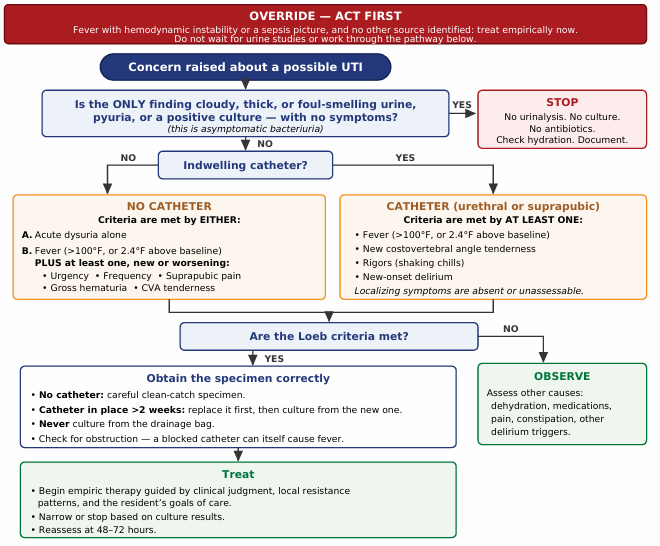
Cloudy Urine, Pyuria, and UTI: A LTC Reference:
Suspected urinary tract infection is the most common trigger for antibiotic use in long-term care, yet the majority of these episodes do not represent a true, treatable infection. This report consolidates the IDSA asymptomatic bacteriuria guideline, the Loeb minimum criteria, and the supporting outcome literature into a single reference for physicians, nurse practitioners, physician assistants, nursing staff, and hospice staff. The goal is to align all provider practices with the facility’s antibiotic stewardship program.
Cloudy, thick, or foul-smelling urine is not a reason to test or treat. Urine appearance and odor reflect hydration and are excluded as criteria by both IDSA and Loeb.
Pyuria does not indicate infection in this population. Roughly 90% of long-term care residents with asymptomatic bacteriuria also have pyuria, so a “positive” urinalysis rarely changes the diagnosis.
New confusion or a fall, without fever or hemodynamic instability, should prompt a broad evaluation — not a urine culture. Delirium in these residents is far more often caused by medications, retention, dehydration, or pain than by a UTI.
Catheterized residents follow a distinct pathway: a higher bar to begin looking (systemic signs only), but a lower bar to treat once those signs appear, given the catheter’s direct route to the bloodstream.
Reducing antibiotic use through these criteria is supported by evidence. Four randomized trials found no increase in hospitalization, sepsis, or death, while the harms of overtreatment — Clostridioides difficile, resistance, and adverse drug eventsare well documented.
Antibiotic decisions by hospice and other services fall within our stewardship program’s scope and are surveyable under F881, making shared criteria a compliance issue as well as a clinical one.
Guardianship Bill of Rights (HB 26-1100)
DOWNLOAD-Guardianship Bill of Rights – Update effective August 12, 2026
Effective August 12, 2026 — relevant to residents with a court-appointed guardian
Governor Polis signed House Bill 26-1100 on May 29, 2026, adding a new “Guardianship Bill of Rights” to Colorado law (C.R.S. § 15-14-103) and amending guardian duties under § 15-14-314. The law applies to any resident who is under an active court guardianship (a “ward”). Two provisions are directly relevant to our operations and should be reviewed with admissions, social work, and nursing leadership.
1. Thirty-Day Advance Notice Before Admission
Under new § 15-14-314(2)(h), a guardian must notify the ward at least 30 days before a planned permanent move into a nursing home or other facility that restricts the ward’s ability to leave or have visitors — unless the move is already specified in the guardian’s care plan or separately authorized by the court.
- Admissions/social work should confirm, for any incoming resident with a guardian, that this notice was given (or that an exception applies) as part of intake documentation.
- This is a guardian obligation, not a facility obligation — but facilities should be prepared to document that it was met, since it may be reviewed if a placement is contested.
2. Capacity Determinations Must Be Right-Specific
The new bill of rights (§ 15-14-103(1)(s)) gives a ward the right to a court review if a question arises about their capacity to exercise a specific right. A single global cognitive score or overall capacity finding may not be used to restrict multiple, unrelated rights at once.
- Capacity assessments and physician statements should tie any recommended restriction to the specific decision at issue (e.g., medical treatment, finances, social contact) rather than citing a BIMS score or global cognitive screen as a blanket justification.
- This reinforces existing best practice under the DOJ–Colorado Settlement Agreement (Olmstead/ADA) and should be reflected in physician statement templates and IDT documentation going forward.
Also Worth Knowing
Residents under guardianship retain rights to privacy, religious practice, personal dignity, and participation in care decisions “to the extent possible,” even with an active guardian. The full text enumerates additional rights (legal counsel, hearing participation, confidentiality, and the right to petition the court to modify or end the guardianship) that are more relevant to the guardianship proceeding itself than to day-to-day facility operations, but staff fielding resident or family questions about guardianship should be aware they exist.
Addressing Substance Abuse in LTC
Our ethics committee discussed the case this month involving a patient with an alcohol abuse history and current alcohol abuse behaviors. The patient does not want to quit drinking alcohol but is taking on many risky behaviors both inside of the building and when the patient leaves the building. We had a good discussion and I wanted to outline some components of an Action Plan to address such situations.
Action Plan:
- Offer counseling for substance abuse.
- Offer medical therapies for substance abuse when available.
- Attempt to replace drug-seeking and use behaviors with non-substance-associated behaviors.
- Behavioral contract:
- Outline specific risks as much as possible — risks with medication interactions, falls, being hit by a vehicle crossing the street, ETOH toxicity, seizures, cirrhosis, dementia, cognitive decline, weight loss, malnutrition, etc.
- Ensure the patient understands the risks and your concerns, and ask the patient to sign the contract outlining that you have discussed the risks.
- The contract can help the person formally assume responsibility for the risky behavior.
- Investigate outpatient and inpatient programs for substance abuse.
- Investigate required, involuntary treatment: court-ordered or involuntary commitment (Substance use commitment | Behavioral Health Administration).
- Ensure close communication with the resident for safety monitoring:
- Attempt to call the patient to check in when they are out of the building.
- Create a plan for this communication and provide avenues for the patient to ask for help and communicate other information to ensure patient safety.
- Monitor the patient’s condition upon return to the facility to ensure safety after substance use.
- Monitor for others enabling unhealthy behaviors and provide the patient with intervention options to avoid acquaintances that enable the patient.
- Offer supervision of the patient’s substance use if possible.
- Document ALL of it!